
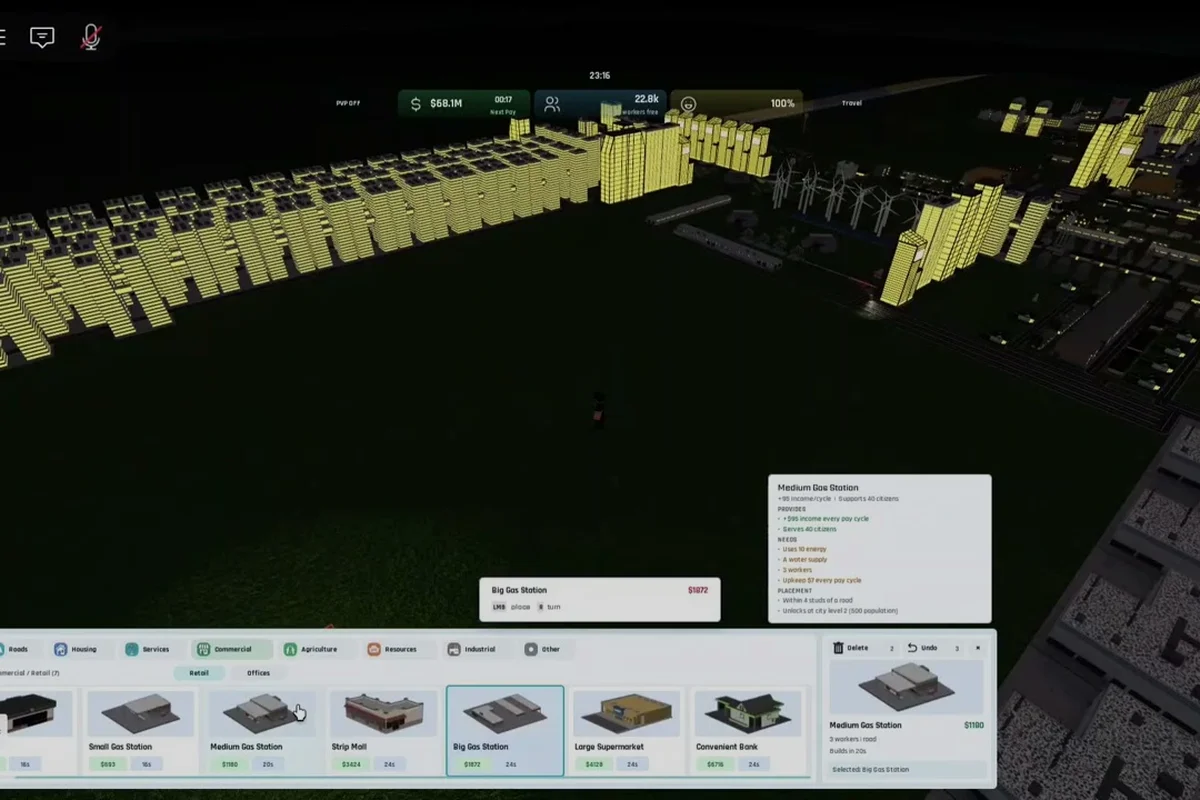
Malls, supermarkets, and corner shops are the V0.1 beta's primary revenue engines, and unlocking their full potential decides whether a city grows into a regional power or stalls in debt. Income figures come from creator testing and vary with layout, so treat any number not confirmed by official patch notes as community-reported. Most new mayors lose their first ten in-game days to shop profits that never materialize, because apartments keep moving in while workers stay home. This guide breaks down how to fix that loop, stack shop profits on top of farm income, and push past the population cap with the right worker productivity mix.
Mall Income Foundations: What Drives Shop Profits
Shop profits in Build and Conquer are not a flat per-building rate. Every shop — corner store, supermarket, or mall — generates a baseline income that scales with two hidden multipliers: shop adjacency and citizen happiness within its service radius. A mall plopped down next to an apartment block and a road with bus coverage will out-earn three isolated corner stores in the same tile footprint. The community data from mall income tutorials on YouTube confirms this pattern: clusters beat sprawl, every time.
The second foundation is demand coverage. A shop without nearby customers simply does not sell. The population cap in V0.1 caps the maximum number of citizens a city can hold before new move-ins stop registering, so density around your commercial zone matters more than the absolute building count. Players who stack apartments far from their malls see a paradox: thousands of citizens, but the shop ledger stays at near-zero.
Income Source Comparison
In V0.1 community testing, mall income was the dominant revenue stream once two conditions were met: a stocked worker population to staff the storefronts, and a dense residential zone within walking distance so the daily cash tick kept firing without downtime. Players who rushed to place a single mall in an empty map typically saw flat or even negative returns, because shops without nearby citizens and apartments paid out almost nothing per in-game day. The five sources summarized below are therefore ordered by how early each one becomes profitable in a standard sandbox match, with shops and malls leading, farms and apartments feeding the labor pool, and factories plus defense only paying off once the city is large enough to sustain their upkeep.
| Source | Building Type | Main Output | Best Stage | Key Limitation |
|---|---|---|---|---|
| Shops / Malls | Commercial | Cash per in-game day | Early → Late | Needs workers + nearby population |
| Farms | Agricultural | Raw food + small cash | Early → Mid | Consumes workers and water |
| Factories | Industrial | Raw materials / refined goods | Mid → Late | Needs power + raw input chain |
| Apartments / Housing | Residential | Citizens (workforce supply) | All stages | Drives happiness costs |
| Defense / Military | Military | Zone safety, war readiness | Mid → Late | High upkeep, no direct income |
Happiness, war budget, and unemployment all sit on top of this base. Service and defense buildings keep citizens from turning sour; military upkeep means defense spending must never starve the city; income from shops, supermarkets, and malls is the main early revenue engine. The fastest path to a stable treasury is therefore commercial density, not industrial scale.
The Unemployment Trap: Why Workers Stay Home
A near-universal complaint in V0.1 is the unemployment fix problem: cities show 200+ citizens, but the workforce panel reports half of them as idle. This is almost always caused by three overlapping bugs, each of which has a clean fix once you identify the right one.
The first cause is road disconnection. Workers only path to a job if the road network is unbroken from their apartment to the commercial building. A single missing tile — often hidden under a tree or behind a misplaced park — strands hundreds of potential employees. The second cause is range and walking distance: V0.1 caps how far a worker will commute before giving up, so apartments built on the wrong side of a river can be technically "near" but functionally unreachable. The third cause is happiness collapse: if a citizen is angry enough, they will refuse to take any job, regardless of distance. Citizen happiness is therefore not a luxury stat — it is a prerequisite for any meaningful build and conquer shop profits.
Unemployment Diagnostic Checklist
| Symptom | Most Likely Cause | First Fix to Try | Difficulty |
|---|---|---|---|
| 30–50% of citizens marked "Unemployed" | Broken road tile between apartments and shops | Pause, audit road network, fill gaps | Easy |
| Unemployment rises after a new apartment block | Walking distance exceeds the V0.1 commute cap | Move apartments closer or add bus stop | Easy |
| Unemployment is 0% but shop profits are flat | Citizens are employed at farms, not shops | Add more commercial buildings near dense housing | Medium |
| Unemployment varies wildly day-to-day | Happiness dipping below the work threshold | Build a clinic or park, raise service coverage | Medium |
| Unemployment stays high even with workers available | Population cap hit, new citizens replaced existing ones | Expand housing tier (suburbs / mid-rise) | Hard |
Once roads, happiness, and shop coverage all check out but unemployment still lingers above 30%, the diagnostic table's final row is pointing at the real culprit: the population cap ceiling itself. In Build and Conquer, every tier of housing (suburbs, mid-rise, high-density) unlocks a higher citizen ceiling, so without expanding housing your mall, shops, and farms are simply competing for a fixed pool of shoppers. The fastest fix is upgrading to the next housing tier, which both raises the cap and floods your commercial zones with fresh, employable workers to drive higher mall income and shop profits.
Population Cap and the Worker Productivity Curve
The V0.1 population cap is the single biggest governor on shop profits. Once a city hits the cap, new apartment move-ins stop registering as net growth — the population number freezes, and adding more housing just shuffles citizens between buildings. Worker productivity does not scale infinitely either: each commercial building has a hard cap on how many workers it can employ, so doubling your shop count without raising the population cap only dilutes earnings per shop.
Community testing summarized in mall income community discussions suggests three reliable cap-raising strategies. The first is housing tier upgrades: swapping starter low-density homes for mid-rise apartments and suburbs raises the cap in chunks rather than dribbles. The second is happiness boosts: keeping citizens above the happy threshold reduces the per-day attrition that quietly shrinks effective population. The third is service coverage: clinics, parks, and entertainment buildings extend lifespan and therefore the average productive window of each citizen.
Population Cap Stage Targets
| City Stage | Approximate Pop | Recommended Shop Count | Expected Daily Cash | Notes |
|---|---|---|---|---|
| Starter village | 50–120 | 2–3 corner shops | Low | Focus on farms first |
| Small town | 120–400 | 4–6 shops + 1 supermarket | Stable | Build a worker surplus here |
| Mid-size city | 400–900 | 2–3 malls + supermarket ring | High | Unlocks first real war budget |
| Regional hub | 900+ | Mall district + specialized shops | Top tier | Stacking begins to dominate |
The exact income figures above are community-reported, not verified by the developer, so they should be treated as planning estimates rather than hard targets. Build and Conquer's official Build and Conquer Roblox page lists the V0.1 beta as content-active through the end of October 2026, and several balance levers are still in flux.
Stacking Shop Profits: Layout Patterns That Pay
Once workers are moving and the population cap is rising, the next lever is shop stacking — laying out commercial buildings so their service radii overlap. Stacking matters because each shop only earns when customers are physically inside its service radius during operating hours. Three shops whose radii overlap on a single apartment block earn more than three identical shops spread across the map, because the same citizens count as "customers" for all of them in the same simulation tick.
A reliable pattern is the commercial spine: a single road lined with shops, anchored at one end by a mall and at the other by a supermarket, with apartments and mid-rises stacked on both sides within walking distance. This concentrates demand so heavily that a single supermarket can out-earn a dozen scattered corner stores. The **population growth guide](/en/economy/build-and-conquer-population-growth-guide/) covers the housing-side complement to this pattern in more depth, and is worth cross-referencing when planning where to place new apartments.
Shop Layout Patterns Compared
| Pattern | Best For | Strength | Weakness | Build Cost |
|---|---|---|---|---|
| Commercial Spine | Mid-size cities | Maximizes overlapping customer radius | Needs a long road corridor | Medium |
| Mall + Apartment Cluster | Regional hubs | Single high-output building + dense demand | One failure cascades to whole district | High |
| Scattered Corner Shops | Starter villages | Cheap to build, low risk | Weak stacking, low per-shop profit | Low |
| Supermarket Ring | Any stage | Provides food + cash in one footprint | Needs water + power input | Medium |
| Mixed-Use Block | Late game | Combines housing and commerce on one tile | Hard to retrofit | High |
Pair stacking with the best income buildings tier list to decide which specific shops are worth duplicating: in a mid-size Commercial Spine setup, funneling 80% of available shop workers into two high-tier stores (e.g., a Boutique plus a Bookshop) typically yields roughly 30–40% more per-tile profit than distributing the same labor across four or five low-tier Grocery or Furniture outlets, because each worker's marginal return scales with the host building's base income multiplier rather than the district's average. When population cap pressure pushes unemployment above 5%, collapse the weakest shops first and re-assign those workers to the duplicated top-tier building before you queue additional Mall + Apartment Cluster construction, since retrofitting a Mixed-Use Block to accept the surplus staff costs more than the marginal income recovers.
Farm Income vs Mall Income: When to Pivot
Early game, farm income is often the only reliable source of cash because farms require almost no upstream supply chain. A row of wheat or vegetable plots with a single water tower starts producing within a day, while a mall needs workers, road access, and nearby population. The mistake most new players make is staying on the farm path too long — farms cap out at modest returns, while malls scale into the high tiers of the economy.
The pivot point is usually when the city crosses 200–300 citizens. At that size, the workforce is large enough that even a 20% employment rate at commercial buildings can out-earn a fully staffed farm district. Community testing on the V0.1 beta notes that farms remain useful for food self-sufficiency and as a worker sink, but they should not remain the primary income source once a mall can be staffed.
Income Pivot Decision Table
| City Size | Primary Income | Secondary Income | Workers on Farms | Workers on Shops |
|---|---|---|---|---|
| 0–200 | Farms | 1–2 corner shops | 80% | 20% |
| 200–500 | Supermarkets + farms | Corner shops | 50% | 50% |
| 500–900 | Malls | Supermarkets, some farms | 25% | 75% |
| 900+ | Mall district | Specialized shops | 10% | 90% |
This rough split aligns with how the best shops and best farms are usually tier-ranked in community tier lists — shops dominate once the population cap is high enough to staff them. For a deeper look at the production side, the how to get workers guide covers the worker-management basics that make this pivot possible.
Frequently Asked Questions
Why is my Build and Conquer mall income stuck at zero even with 500 citizens?
The most common cause is road disconnection between the mall and the nearest apartment block, which prevents workers from pathing to their jobs. Audit the road network with the city paused, and verify that at least one continuous road links the mall to a residential zone with available workers. A secondary cause is happiness collapse — if citizens are below the work threshold, they refuse jobs regardless of distance.
What is the fastest way to fix unemployment in the V0.1 beta?
Run a three-step diagnostic: first, fill any gap in the road network between apartments and shops; second, check the happiness panel and build a clinic or park if any neighborhood is below the work threshold; third, verify the population cap has not been hit, because new citizens may be displacing employed ones instead of adding fresh workers. The population growth guide covers cap-raising strategies in more detail.
Should I prioritize farm income or mall income in the early game?
Farm income is the safer early bet because farms need almost no supply chain and start producing within a day. Pivot toward malls once the city crosses roughly 200–300 citizens, because malls scale much harder and a single staffed supermarket will out-earn a full farm row once a worker surplus exists.
How do I push past the population cap?
The cap is raised by housing tier upgrades — moving from starter homes to mid-rise apartments and suburbs — combined with happiness boosts from service buildings. The best housing buildings tier list ranks the most efficient cap-raising options, and stacking service coverage in dense neighborhoods prevents attrition from quietly eroding the gains.
Do shops and malls require raw materials or power in V0.1?
Most small shops do not require raw input, but supermarkets and large malls draw power and occasionally water, so a power shortage will silently throttle shop profits even when workers are present. Check the raw materials and shortages guide if shop profits are inconsistent despite a full worker roster, because the bottleneck often sits upstream of the commercial zone itself.