
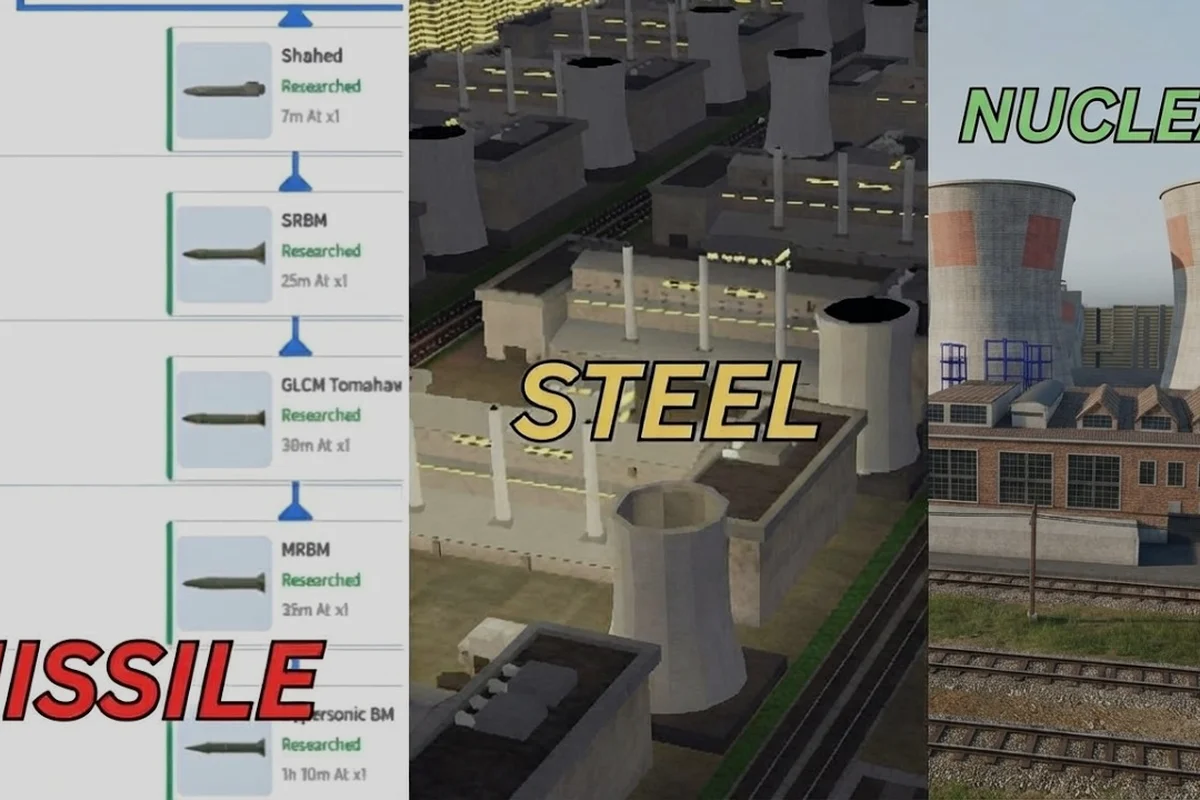
Missiles are the decisive endgame weapon in Build and Conquer, capable of erasing entire districts or breaking a fortified defense line in a single launch. This Build and Conquer missile guide breaks down every unlockable type, the quest chain that gates your first launch, and the tactical roles each system fills on the battlefield. Understanding the missile progression path matters because wasting early research on the wrong branch can set your military development back by several in-game hours. Once you know which warhead fits your strategy, follow the step-by-step unlock requirements in Build And Conquer How To Unlock Missiles to avoid dead-end research.
The Military Base Path to Your First Missile
The path to your first missile in Build and Conquer runs through the military base, which serves as the central hub for all strategic weapons development. According to the official Roblox game page, the current V0.1 beta launched on 2026-08-23 and supports up to 8 players per server, which means missile unlocks are designed to be contested objectives rather than passive upgrades. Community footage from October 2026 confirms that the unlock order is creator-verified, although exact damage and cooldown numbers remain unpublished.
The quest line that gates missile access requires you to destroy enemy ground units or buildings, which feeds directly into the progression tracker. This design choice forces players to maintain an active offensive presence instead of turtling behind walls while waiting for research timers. The first two unlocks follow a strict sequence, and skipping ahead is impossible because each missile type requires the previous one to be operational before the next quest stage activates.
| Unlock Order | Missile Type | Unlock Location | Quest Requirement | Verified Status |
|---|---|---|---|---|
| 1 | SRBM | Military Base | Destroy enemy ground units | Creator-verified |
| 2 | GLCM | Military Base | Destroy enemy buildings | Creator-verified |
| 3 | MRBM | Military Base | Progress through quest line | Creator-verified |
| 4 | Hypersonic BM | Military Base | Final unlock | Creator-verified |
The SRBM (short-range ballistic missile) is the entry point for every player's strategic arsenal, and it unlocks first at the military base after you complete the initial destruction objectives. The GLCM (ground-launched cruise missile) follows as the second step of the quest line, introducing a different flight profile that trades speed for terrain-hugging maneuverability. Because the beta changed frequently during October 2026, any numeric value not listed in the verified briefing should be treated as community-reported rather than official data.
First Missile Unlock Requirements
Getting your first missile operational requires more than just completing the quest objective. You need a functional military base with the appropriate launch infrastructure, which means investing in power generation, crew quarters, and the silo or launcher structure itself. Community reports indicate that players who rush the military base without supporting logistics often find their first SRBM sitting idle because the launch platform lacks the necessary power draw.
The quest tracker only counts destruction events that occur after you accept the missile unlock mission, so early-game skirmishes do not retroactively apply. This detail catches many new players off guard because they assume their previous kills count toward progression. Plan your first offensive push after accepting the quest, then focus on soft targets like unguarded resource buildings to complete the requirement quickly.
Missile Type Comparison and Tactical Roles
Each missile in the Build and Conquer arsenal fills a distinct tactical niche, and understanding these differences prevents wasted launches against inappropriate targets. The MRBM (medium-range ballistic missile) delivers heavier strikes than the SRBM, making it the preferred option for cracking reinforced positions or command centers. The Hypersonic BM represents the final unlock and carries a very high chance to slip past anti-missile systems, which makes it the ultimate counter to players who invest heavily in missile defense.
The damage hierarchy follows a predictable escalation pattern, but the exact numbers are not published by the developer. Community testing suggests that each tier represents a meaningful jump in destructive potential, with the Hypersonic BM capable of leveling structures that would survive multiple SRBM hits. Because interception mechanics exist in the game, the Hypersonic BM's penetration chance is often more valuable than raw damage output.
| Missile Type | Flight Profile | Best Target | Interception Risk | Unlock Tier |
|---|---|---|---|---|
| SRBM | High arc ballistic | Light buildings, infantry clusters | Moderate | Entry |
| GLCM | Terrain-hugging cruise | Supply lines, radar installations | Low | Second |
| MRBM | Medium arc ballistic | Reinforced structures, command posts | Moderate | Third |
| Hypersonic BM | High-speed ballistic | Anti-missile defended targets | Very low | Final |
The GLCM deserves special attention because its low-altitude flight path allows it to slip under radar coverage that would detect a ballistic missile early in its trajectory. Players who rely on early warning systems often find cruise missiles detonating on their doorstep with minimal reaction time. The tradeoff is speed, since a terrain-hugging approach takes longer to reach distant targets than a high-arcing ballistic trajectory.
Ballistic vs Cruise Missile Fundamentals
The Build and Conquer ballistic missile guide distinction comes down to flight path and detection window. Ballistic missiles climb steeply after launch, reach high altitude, then descend on their target at extreme speed, which gives defenders a longer detection window but a shorter interception window once the missile commits to its terminal dive. Cruise missiles fly low and slow by comparison, trading speed for stealth and making them ideal for hitting targets that sit behind early warning networks.
Choosing between ballistic and cruise options depends on what your opponent has built. If they invested in radar coverage and anti-missile batteries, the GLCM's low-altitude approach bypasses much of that investment. If they rely on point-defense systems clustered around key structures, a ballistic missile's high-speed terminal phase may overwhelm the interceptors before they can acquire a firing solution.
Nuclear Missile Capabilities and Strategic Impact
The Build and Conquer nuclear missile guide topic generates significant community interest, although the V0.1 beta does not currently list a dedicated nuclear warhead option in the verified unlock order. The four confirmed missile types are SRBM, GLCM, MRBM, and Hypersonic BM, with no nuclear variant appearing in creator-verified documentation as of October 2026. Players asking about nuclear capabilities should treat any nuclear missile claims as speculation or future content rather than current beta features.
That said, the Hypersonic BM functions as the de facto strategic weapon in the current build, delivering the heaviest confirmed payload with the highest interception resistance. Its role in the meta mirrors what a nuclear option would provide: a near-unstoppable strike that forces opponents to spread out their infrastructure or accept catastrophic losses. The psychological impact of seeing a Hypersonic BM launch often triggers immediate defensive repositioning from the target player.
| Strategic Weapon | Confirmed in V0.1 | Role | Community Status |
|---|---|---|---|
| Nuclear Missile | No | Speculated future content | Unverified |
| Hypersonic BM | Yes | Top-tier strategic strike | Creator-verified |
| MRBM | Yes | Heavy tactical strike | Creator-verified |
| GLCM | Yes | Stealth precision strike | Creator-verified |
The absence of a confirmed nuclear option means players should focus their strategic planning around the Hypersonic BM as the ultimate deterrent. Investing in the full missile unlock chain provides access to every confirmed weapon system, and the final Hypersonic unlock represents the peak of the current strategic arsenal. Any guide claiming nuclear missile functionality in the V0.1 beta is working from outdated or fabricated information.
Anti-Missile Systems and Counterplay
Defending against missiles requires understanding the interception mechanics that the Hypersonic BM is specifically designed to defeat. Community reports describe anti-missile systems as point-defense installations that can shoot down incoming ballistic missiles during their terminal phase, with effectiveness varying based on the incoming missile's speed and flight profile. The Hypersonic BM's very high chance to slip past these systems makes it the hard counter to defensive players.
The counterplay loop creates interesting strategic tension: investing in anti-missile defenses protects against SRBM and MRBM strikes but leaves you vulnerable to the final Hypersonic unlock. Players who skip missile development entirely and rely on conventional forces can be punished by a single well-placed GLCM strike that bypasses their early warning network. This rock-paper-scissors dynamic keeps the late-game meta from settling into a single dominant strategy.
Missile Launch Range and Positioning Strategy
Effective missile usage depends heavily on launch platform positioning and understanding the range limitations of each system. The Build and Conquer missile launch range varies by type, with ballistic missiles generally reaching farther than their cruise missile counterparts due to their high-altitude flight path. Positioning your launch infrastructure near the front line reduces flight time but exposes it to counterattack, while rear-area placement trades responsiveness for survivability.
Community footage from the V0.1 beta shows players experimenting with forward missile bases that sit just behind the main battle line, allowing rapid strikes against targets that conventional artillery cannot reach. This aggressive positioning works well when you maintain air superiority or have sufficient point-defense coverage, but it creates a high-value target that opponents will prioritize. The decision of where to place your missile infrastructure is as important as which missile type to unlock first.
| Positioning Strategy | Advantages | Disadvantages | Best For |
|---|---|---|---|
| Forward base | Short flight time, rapid response | Vulnerable to raids | Aggressive players |
| Rear area | High survivability | Long flight time | Defensive players |
| Dispersed silos | Hard to eliminate all | Higher logistics cost | Late-game empires |
| Mobile launchers | Repositionable | Lower payload capacity | Hit-and-run tactics |
The missile silo structure provides the most protection for your launch capability, but it locks the missile into a fixed position that opponents can target once they locate it. Mobile launchers offer flexibility at the cost of reduced payload or longer reload times, depending on the specific unit. Because the beta does not publish exact range numbers, treat any specific distance claims as community estimates rather than verified data.
Missile Spam and Counter Tactics
The missile spam strategy involves building multiple launch platforms and firing salvos that overwhelm enemy interception systems through sheer volume. This approach works because anti-missile defenses have limited engagement capacity, and a coordinated salvo of four or five SRBMs can exhaust the defender's interceptors before the final missile reaches its target. The strategy requires significant resource investment but can break a stalemate that conventional forces cannot resolve.
Countering missile spam requires layered defense: early warning radar to detect launches, anti-missile batteries to engage incoming threats, and offensive pressure to destroy launch platforms before they can fire follow-up salvos. Players who invest exclusively in interception without a counterattack capability find themselves slowly ground down by repeated missile strikes. The most effective defense combines interception with aggressive raids on enemy missile infrastructure.
Missile Research Priority and Build Order
Optimizing your missile development path requires understanding the opportunity cost of each unlock. The SRBM is mandatory as the first step, but after that you face choices about whether to rush the GLCM for stealth capabilities or push toward the MRBM for heavier strikes. Community consensus suggests that the GLCM's unique flight profile makes it the higher-value second unlock because it opens up targets that ballistic missiles struggle to hit effectively.
The full unlock chain to the Hypersonic BM represents a significant investment of time and resources, and players must weigh this against developing conventional military forces. A balanced approach that maintains ground forces while progressing through missile unlocks tends to outperform a pure missile rush, because missile infrastructure is vulnerable to direct attack and requires conventional protection.
| Build Order | Priority | Rationale | Risk Level |
|---|---|---|---|
| Military base + SRBM | High | Entry requirement | Low |
| GLCM | Medium | Stealth capability | Low |
| Ground forces expansion | Medium | Protect missile assets | Medium |
| MRBM | Medium | Heavy strike option | Medium |
| Hypersonic BM | High | Final strategic weapon | High |
The missile unlock quest chain rewards consistent offensive action, which means players who maintain pressure on opponents progress faster than those who turtle. This creates a positive feedback loop where aggressive players unlock better weapons that enable more aggression. Defensive players can still access missiles by launching targeted raids specifically to complete quest objectives, but they progress more slowly than their offensive counterparts.
Resource Management for Missile Programs
Missile production and launch consume significant resources, and managing this economy separates successful missile commanders from those who bankrupt themselves on a single salvo. Each missile requires both the initial construction cost and ongoing maintenance for the launch platform, which means idle missile infrastructure drains resources even when not firing. Community reports emphasize the importance of building missile capacity only when you have a specific target in mind.
The resource cost scales with missile tier, so a Hypersonic BM represents a much larger investment than an SRBM. Players who unlock high-tier missiles but lack the economy to produce them find themselves with expensive infrastructure and no ammunition. Build your economic base alongside your missile program to ensure you can actually afford to fire the weapons you unlock.
Frequently Asked Questions
How do I get my first missile in Build and Conquer?
Your first missile is the SRBM, which unlocks at the military base after completing the initial quest requirement to destroy enemy ground units or buildings. Accept the missile unlock quest first, then focus on destroying soft targets like unguarded resource structures to complete the objective quickly.
What is the best missile in Build and Conquer?
The Hypersonic BM is the best missile because it delivers the heaviest confirmed strike with a very high chance to slip past anti-missile systems. Its combination of destructive power and interception resistance makes it the ultimate strategic weapon in the current V0.1 beta meta.
Is there a nuclear missile in Build and Conquer?
No nuclear missile is confirmed in the V0.1 beta as of October 2026. The verified unlock order includes only SRBM, GLCM, MRBM, and Hypersonic BM. Any nuclear missile claims should be treated as speculation about future content rather than current game features.
How do I unlock all missiles in Build and Conquer?
Complete the missile unlock quest chain at the military base, which requires destroying enemy ground units and buildings to progress through each stage. The unlock order is SRBM first, then GLCM, then MRBM, and finally Hypersonic BM as the last unlock.
Can missiles be intercepted in Build and Conquer?
Yes, anti-missile systems can intercept incoming ballistic missiles during their terminal phase, with effectiveness varying by missile type. The Hypersonic BM has a very high chance to slip past these defenses, while slower cruise missiles like the GLCM avoid detection through low-altitude flight.