
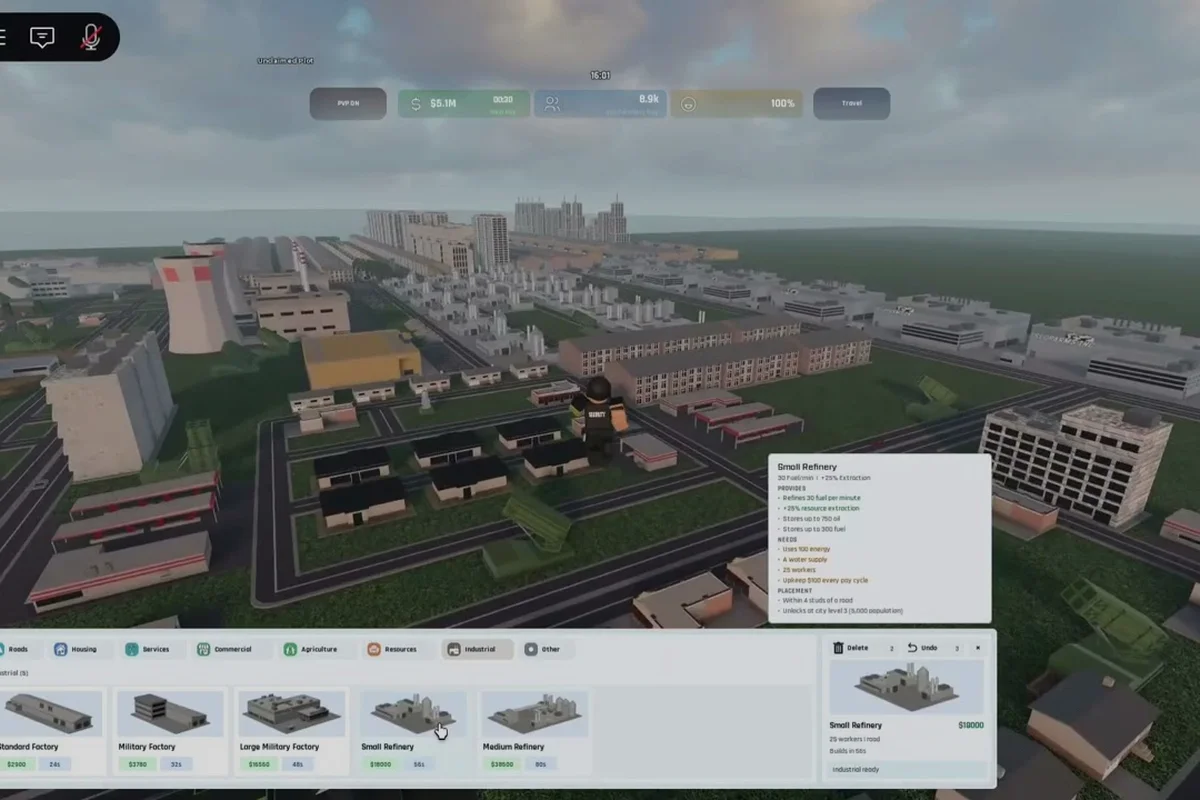
Fuel production in Build and Conquer is the backbone of any mechanized offensive, because vehicles and heavy warfare consume fuel at a rate that quickly outpaces early-game stockpiles. Without a stable refinery pipeline and a grid that scales alongside every new factory, your armored pushes stall before they reach the front line. This guide breaks down the verified V0.1 beta mechanics, community-tested ratios, and the power infrastructure you need to keep fuel flowing without brownouts.
How Refineries Turn Raw Nodes into Vehicle Fuel
The fuel production chain in Build and Conquer starts with raw resource extraction and ends with refined fuel that vehicles burn during combat operations. According to the official Build and Conquer game page, the V0.1 beta launched on August 23, 2026, and the resource economy has shifted multiple times since then. Community reports from October 2026 confirm that fuel is consumed exclusively by vehicles and mechanized warfare, which means your production targets must align with your offensive tempo rather than a static stockpile goal.
Raw Inputs and Refinery Placement
The first bottleneck most players hit is not the refinery itself, but the raw resource throughput feeding it. Steel acquisition changed in a recent update, so any chain you remember from earlier beta builds needs re-verification against the live V0.1 state. Community footage from the current beta shows that refineries placed far from raw resource nodes create idle refinery time, which is the single largest hidden cost in fuel production. A refinery that waits for input is a refinery that is not producing, and every second of idle time compounds across a multi-hour session.
| Production Stage | Key Input | Common Failure Point | Community-Reported Fix |
|---|---|---|---|
| Raw extraction | Iron ore | Node depletion without rotation | Rotate extraction sites before full depletion |
| Refinement | Steel | Refinery idle time from long haul routes | Place refineries adjacent to ore nodes |
| Fuel synthesis | Refined steel | Grid brownout halting synthesis | Add buffer power before scaling fuel output |
| Vehicle consumption | Fuel | No reserve during offensive pushes | Maintain 20% fuel reserve above active demand |
The table above reflects community-reported patterns from the V0.1 beta, not official damage or cost numbers. Because the beta changed often in October 2026, treat any specific numeric claim outside the verified briefing as unverified until you test it on your own server.
Why Power Is the Hidden Fuel Input
Every refinery and factory in Build and Conquer draws from the same grid, which means your fuel production is only as reliable as your power generation. The verified briefing states that grid output must scale with every new factory, and this is where most fuel-focused players stumble. You add a second refinery to double fuel output, but the grid browns out, and both refineries run at reduced efficiency. The result is a net fuel loss compared to running one refinery at full power.
Scaling Refinery Output Without Crashing the Grid
Scaling fuel production in Build and Conquer is a balancing act between refinery count, grid headroom, and raw material supply. The most common mistake is treating fuel production as a linear problem: add more refineries, get more fuel. In practice, each refinery adds a discrete power draw that can tip your grid into brownout territory, which then cascades into reduced output across every factory on the network.
The Grid Headroom Rule
Before adding any refinery, check your current power surplus. Community data suggests keeping at least a small buffer above active demand, because vehicle production spikes and simultaneous factory activations can create momentary draw spikes that a perfectly balanced grid cannot absorb. A grid running at 100% capacity is a grid that fails the moment you queue a new vehicle or activate a second production line.
| Grid State | Refinery Efficiency | Risk Level | Recommended Action |
|---|---|---|---|
| 30%+ surplus | Full output | Low | Safe to add one refinery |
| 10-30% surplus | Full output | Medium | Add buffer power first |
| 0-10% surplus | Reduced output during spikes | High | Do not scale until buffer added |
| Negative (brownout) | Severely reduced | Critical | Shut down non-essential factories |
This table is a planning framework based on community-reported behavior in the V0.1 beta, not an official efficiency chart. The exact efficiency loss at each grid state varies by server and update, so use it as a decision guide rather than a precise calculator.
Buffer Power Before Refinery Expansion
The correct expansion order is power first, refinery second. Build your buffer generation capacity before you place the new refinery, because the construction time for power infrastructure is often shorter than the recovery time from a grid collapse. A brownout that halts fuel production for even a few minutes can cost more fuel than the new refinery would have produced in its first hour of operation.
Power Generation Options for Fuel-Heavy Builds
Build and Conquer offers multiple power generation paths, and the right choice depends on your resource priorities and how far you have progressed through the tech tree. The verified briefing confirms that power is a core resource that must scale with factory count, but it does not provide official generation numbers. Community testing in the V0.1 beta has produced a rough hierarchy of generation options, which you should treat as directional rather than definitive.
Early-Game Generation and Its Limits
Early power generation in Build and Conquer typically relies on basic infrastructure that is cheap to build but limited in output. The problem is that fuel production itself requires a meaningful power draw, which means your early power setup must support both residential zones and industrial production simultaneously. Water network coverage is required for residential zones, and that water infrastructure also consumes power, creating a competing demand that many new players overlook.
| Generation Tier | Typical Use Case | Fuel Production Fit | Community-Reported Limitation |
|---|---|---|---|
| Basic | Early residential + first factory | Marginal | Cannot sustain multiple refineries |
| Intermediate | Mid-game industrial scaling | Adequate | Requires frequent expansion |
| Advanced | Late-game mechanized warfare | Strong | High upfront resource cost |
| Nuclear | Sustained high-output operations | Excellent | Complex setup and management |
The nuclear power guide path in Build and Conquer is the endgame solution for fuel-heavy builds, but it is not a shortcut. Community reports indicate that nuclear setups require significant infrastructure investment before they produce net positive power, which means you need a stable intermediate grid to reach the point where nuclear becomes viable.
Balancing Water, Power, and Fuel
The resource triangle in Build and Conquer is water, power, and fuel, and all three interact in ways that are not immediately obvious. Water network coverage keeps residential zones functional, which keeps your workforce available, which keeps your factories running. Power drives everything, including the water infrastructure and the refineries that produce fuel. Fuel enables the vehicles that protect your resource operations. Break any one link, and the other two degrade.
Advanced Fuel Production Strategies
Once you have a stable grid and a working refinery chain, the next step is optimizing fuel production for sustained warfare. This is where resource management in Build and Conquer shifts from survival to efficiency, and the difference between a good fuel economy and a great one is often a matter of routing, timing, and reserve management. Because fuel reserves often dictate whether your armored columns can press an offensive or stall mid-route, aligning your extraction and distribution priorities with the broader strategic picture is covered in our Build And Conquer Power Balance Guide.
The Reserve Fuel Doctrine
The single most impactful habit for fuel-heavy players is maintaining a fuel reserve above active demand. Vehicles consume fuel during combat operations, and a sudden offensive can drain your stockpile faster than your refineries can replenish it. A reserve buffer of roughly 20% above active demand gives you the flexibility to launch an offensive without stalling your entire production chain.
| Reserve Level | Operational Flexibility | Risk Profile |
|---|---|---|
| 0-10% above demand | Minimal | Any offensive stalls production |
| 10-20% above demand | Moderate | Short offensives possible |
| 20-30% above demand | High | Sustained operations viable |
| 30%+ above demand | Maximum | Overproduction, resources wasted |
The table above is a planning heuristic, not an official mechanic. Community reports from the V0.1 beta suggest that overproduction is a real cost, because stored fuel represents resources that could have been allocated to steel or power infrastructure instead.
Routing and Haul Time Optimization
The distance between your raw resource nodes, your refineries, and your vehicle depots determines how much fuel you lose to logistical overhead. Every second a hauler spends traveling is a second that fuel is not being produced or delivered. Community footage from the current beta shows that players who co-locate refineries with resource nodes and keep vehicle depots near the front line consistently outperform players who build a centralized industrial hub far from their operations.
Frequently Asked Questions
How does fuel production work in Build and Conquer?
Fuel production requires a refinery chain fed by raw resources, with power as a mandatory input. The verified V0.1 beta briefing confirms that fuel is consumed by vehicles and mechanized warfare, and grid output must scale with every new factory. Without stable power, refineries run at reduced efficiency.
What is the best power generation option for fuel-heavy builds?
The best option depends on your tech progression. Early-game basic generation cannot sustain multiple refineries, while nuclear power offers excellent sustained output but requires significant upfront investment. Community testing suggests building intermediate generation first, then transitioning to nuclear once your grid is stable.
How do I avoid brownouts when adding refineries?
Check your current power surplus before adding any refinery. Community data recommends keeping at least a 10-30% buffer above active demand, because simultaneous factory activations create momentary draw spikes. Build buffer power first, then add the refinery, rather than the reverse order.
Why is my refinery producing less fuel than expected?
The most common cause is idle refinery time from long haul routes between resource nodes and refineries. Community footage from the V0.1 beta shows that co-locating refineries with resource nodes dramatically reduces idle time. Grid brownouts are the second most common cause, reducing output across all factories on the network.
Does steel acquisition affect fuel production?
Yes. Steel acquisition changed in a recent update, and steel is a refined material needed for heavy builds and vehicles. Because fuel synthesis depends on the broader industrial chain, any change to steel acquisition ripples through fuel production. Re-check your chains against the live V0.1 build before scaling.