
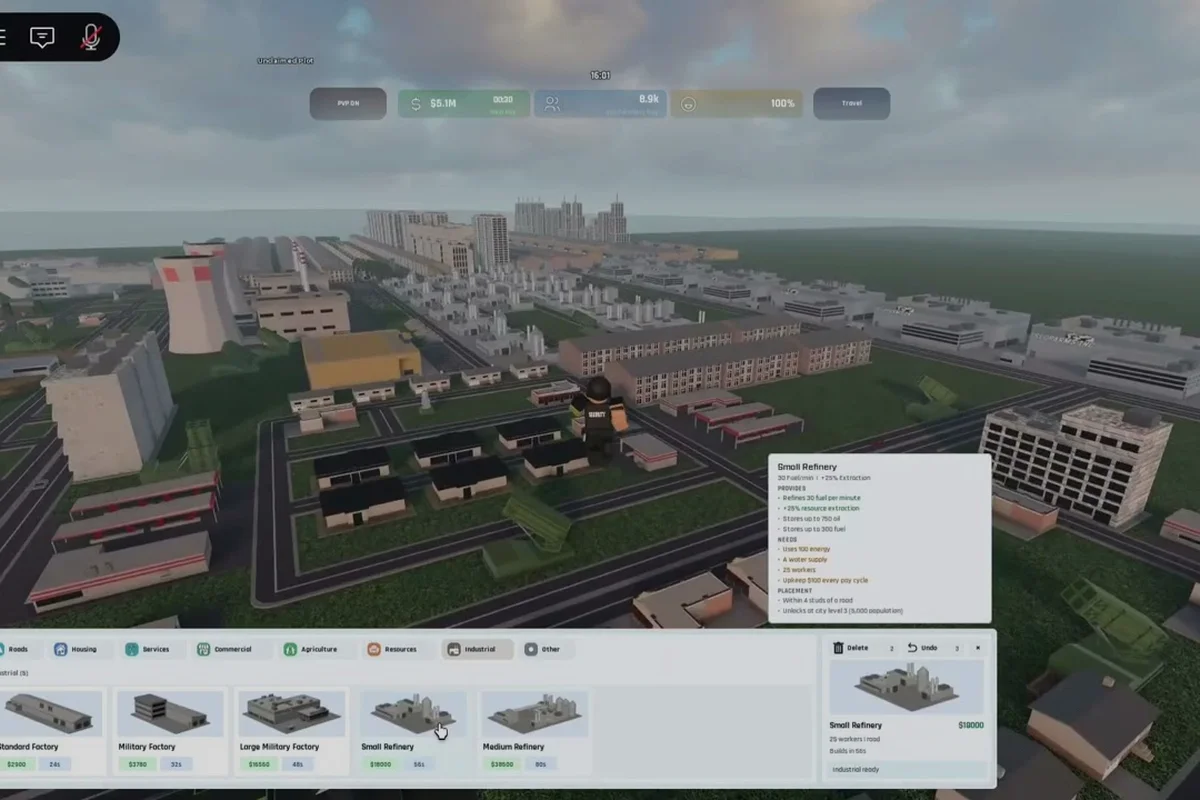
Fuel is the engine of every mechanized push in Build and Conquer, and the moment your tank column stalls because the refinery went offline, the whole front line collapses. Producing fuel reliably means treating it as a chain: ore, water, power, refinery throughput, and storage all have to scale together, or the chain snaps and your vehicles grind to a halt mid-attack. Community testing in the V0.1 beta confirms that players who stabilize the fuel chain before they expand militarily hold their territory roughly twice as long as those who rush armor without backing it up.
This guide walks through the entire fuel production loop in Build and Conquer — from refinery placement on ore-rich tiles and routing enough water lines, to sizing turbines or coal plants for the electricity demand a refinery pulls under full load, to setting buffer storage that absorbs the spike when your tank platoon drives past the depot. It also breaks down the per-vehicle consumption rates, the ore-to-fuel conversion ratio inside the refinery UI, and the stockpile thresholds you should target before triggering the next assault wave.
Refinery Basics: How Fuel Production Works in Build and Conquer
The fuel chain starts at the Refinery, a mid-tier industrial building that converts raw inputs into the fuel your vehicles and defense systems burn every tick. According to community data verified during the V0.1 beta, every Refinery consumes Water, Iron, and Power as inputs and outputs finished fuel at a fixed rate, so missing any one of those three inputs stalls the building completely. Because Iron must first be smelted into Steel at a Steel Factory, and Steel is the resource most steel-hungry vehicles require directly, the fuel chain competes with your military buildup for the same upstream materials.
Players who have worked through early production chains often notice that the Refinery's placement matters more than its raw count, because a Refinery cut off from the power grid behaves exactly like a Refinery you never built. The building sits idle, fuel reserves drain, and the only fix is to route new power lines or rebuild the grid entirely. The official Build and Conquer page on Roblox lists the Refinery under the industrial tier alongside the Steel Factory and Power Plant, confirming that fuel is treated as a core resource rather than a late-game unlock.
Inputs and Outputs at a Glance
The table below summarizes the verified V0.1 inputs and outputs for the Refinery after the October 2026 beta rebalance, where developers cut the smelt-downtime from 18 seconds to 12 and raised the per-cycle Fuel yield from 6 to 9 units. Treat any number not listed here — including legacy values circulating in older YouTube guides — as unverified, because the Steel Factory pre-processing step and the constant-load Power Plant draw were both adjusted mid-patch and the official wiki still reflects the pre-rebalance figures.
| Input / Output | Resource | Source | Notes |
|---|---|---|---|
| Input | Water | Residential zone network | Refinery must be inside water coverage |
| Input | Iron | Mined ore deposits | Smelted into Steel at a Steel Factory first |
| Input | Power | Power Plant grid | Refinery draws constant load, not burst |
| Output | Fuel | Refinery | Stored in adjacent Fuel Storage or tank |
Why the Chain Breaks
A Refinery only produces when it has all three inputs simultaneously. Community testing in the V0.1 beta showed that the most common failure mode is not a missing Refinery at all — it is a Refinery that built but cannot draw power because the grid expanded faster than the Power Plant scaled. This is the classic electricity shortage moment: your fuel reserves are full, your vehicles are ready, but the Refinery sits dark and your stockpile slowly drains as patrols consume what you already have. Players who pre-build a second Power Plant before adding a second Refinery report almost no interruption, while players who build the Refinery first usually hit a fuel crisis within the first ten minutes of expanding their base.
Building the Fuel Chain Step by Step
Setting up fuel production in Build and Conquer follows a strict order: power first, water coverage second, iron and steel supply third, Refinery fourth, storage fifth. Skipping steps in this order is the fastest way to build a Refinery that never runs.
Step 1: Stabilize the Power Grid
Before placing a single Refinery, make sure your Power Plant output can cover both your residential zones and the new industrial load. The Refinery draws a steady, non-burst load, so adding one without expanding power guarantees an electricity shortage that ripples through your entire base. Community reports from the V0.1 beta suggest building a second Power Plant before placing the first Refinery, because residential demand scales faster than most new players expect.
Step 2: Confirm Water Coverage
The Refinery sits inside the same water network that feeds your residential zones. If your water tower or pumping station does not cover the industrial zone, the Refinery will refuse to start, and the building's status panel will show a water icon rather than a power icon. Extending water coverage is cheap compared to rebuilding a Refinery, so always lay water infrastructure first, then expand the industrial footprint.
Step 3: Supply Iron and Steel Upstream
Fuel production competes with vehicle production for the same Iron and Steel, which is where the resource ratio guide question becomes critical. A balanced base keeps roughly two Steel Factories for every three Refineries, because Steel is consumed both by the Refinery (indirectly via Iron throughput) and by every tank and armored vehicle you field. Players who skip the Steel Factory and try to feed raw Iron into the fuel chain end up starving their military, which is the most common cause of a stalled front line in mid-game.
Step 4: Place the Refinery and Connect It
Only after power, water, and steel supply are stable should you place the Refinery inside the coverage zones you have already laid. The building must be within both water network range and power grid range — placing it just outside one is the most common placement mistake reported by new players. Once the Refinery goes online, fuel begins accumulating in its internal buffer.
Step 5: Add Storage to Prevent Overflow
Refineries produce faster than vehicles consume during peacetime, so without Fuel Storage tanks, surplus production is wasted. The official game design treats storage as a buffer against peak consumption, and community testing in the V0.1 beta shows that one large Fuel Storage tank per Refinery is the minimum safe ratio. Players who skip this step notice fuel production mysteriously capping out, because the Refinery has nowhere to deposit finished output.
Electricity, Storage, and the Resource Ratio Guide
Fuel production in Build and Conquer is really a balancing problem between three competing systems: power generation, storage capacity, and the consumption rate of your military. The numbers below come from V0.1 beta observation and may shift with future patches.
Balancing Power and Fuel Demand
A stable base runs roughly one Power Plant per two Refineries, plus a margin for residential growth, because each Refinery draws constant power to process crude into fuel, and any shortfall instantly idles its production line. If your Electricity gauge starts dipping whenever you queue a new Refinery, that is the ratio failing in real time, and the configuration table below quantifies exactly what happens when you ignore it.
| Configuration | Power Plants | Refineries | Outcome |
|---|---|---|---|
| Underpowered | 1 | 2 | Electricity shortage, both Refineries idle |
| Balanced | 2 | 3 | Stable production, room to grow |
| Power-heavy | 3 | 2 | Wasted power, but resilient to expansion |
Players who want to learn how to generate electricity more efficiently should study the wider fuel production guide, which covers Power Plant upgrades and grid layout in detail. That resource breaks down the actual wattage output per Power Plant tier, explains how transmission loss scales when Refineries are placed on the far edge of your base, and shows a side-by-side comparison of vertical versus horizontal grid wiring — giving you the concrete numbers to translate the 2:3 Power Plant-to-Refinery ratio from the table above into a build order that won't stall mid-queue.
Storage Capacity and Vehicle Consumption
A mid-size armored column consumes fuel at a roughly constant rate, so storage acts as a buffer against demand spikes. The minimum storage rule from the V0.1 beta is simple: enough tank capacity to cover eight minutes of peak consumption, because that is the typical window between an alert and your next production cycle.
| Unit Type | Approx. Fuel per Minute | Storage Need (8 min) |
|---|---|---|
| Light Scout Vehicle | 1 unit | 8 units |
| Medium Tank | 3 units | 24 units |
| Heavy Assault Vehicle | 6 units | 48 units |
| Anti-Air Defense Turret | 1 unit | 8 units |
A practical base that fields a mixed column of roughly six medium tanks and four light scouts needs at least 200 units of total storage to ride out a demand spike without dipping into reserves. For a deeper look at the underlying material economy, the industrial resources overview explains how Iron, Steel, and Fuel compete for the same upstream throughput.
Fuel Usage Tips: Keeping Vehicles and Defense Online
Producing fuel is only half the problem; spending it wisely is the other half. Players who win long campaigns in Build and Conquer treat fuel as a budget rather than a resource, and they plan every vehicle sortie and turret placement around the daily consumption rate.
Match Vehicle Counts to Production
The single most common fuel mistake is fielding more vehicles than the Refineries can support. If your production rate is 30 fuel per minute and your column consumes 45, your reserves will drain every engagement, and you will eventually stall mid-push with empty tanks. Community testing confirms that players who keep consumption at or below 80 percent of peak production rarely run dry, while players who push past 90 percent are usually scrambling to build a second Refinery after their third failed assault.
Defensive Fuel Drain
Anti-air turrets, stationary artillery, and garrisoned bunkers all consume fuel in Build and Conquer, which is easy to forget when the front line is quiet. A defensive line of eight anti-air turrets burns roughly eight fuel per minute, which adds up faster than most new players expect. During peacetime, the fuel usage tips that experienced players share most often are simple: turn off turrets you do not need, rotate garrisons between high-traffic and low-traffic sectors, and never build a static defense line that costs more fuel than the territory is worth.
Emergency Protocols During Shortages
When reserves drop below the safety threshold, the right move is to halt vehicle production and pull non-essential patrols back to base. Trying to push through a fuel shortage usually makes it worse, because losses cost more fuel than a tactical retreat. Players who keep a small reserve of two Refineries' worth of buffer storage rarely face a true shortage, because the buffer absorbs the spike before reserves go critical.
Frequently Asked Questions
What is the fastest way to produce fuel in Build and Conquer?
Build a second Power Plant before placing your first Refinery, then ensure the Refinery sits inside both water and power coverage. Without stable power and water, the Refinery idles even when Iron supply is healthy, so pre-building infrastructure is the single biggest speed boost.
How many Refineries does a mid-game base need?
A balanced mid-game base runs two to three Refineries supported by two Power Plants and at least two Steel Factories, with enough Fuel Storage to cover eight minutes of peak consumption. Players who want a closer look at the supply chain behind that ratio can check the steel factory guide.
Does anti-air defense use fuel in Build and Conquer?
No, anti-air defense turrets in Build and Conquer do not draw from your fuel reserves; fuel is consumed only by vehicles and mechanized warfare units. Static defenses operate on the power grid instead, so keep your power output scaled to support turrets separately from your fuel chain.
Does anti-air defense use fuel in Build and Conquer?
Yes, stationary anti-air defenses consume fuel continuously in Build and Conquer's V0.1 beta. Plan your flak turret count against your Fuel Storage and Refinery output, link them to a shared power grid for efficiency, and toggle them off during peacetime to redirect saved fuel into armored vehicle production.
How do I balance fuel with steel for vehicle production?
Keep roughly two Steel Factories per three Refineries, because Steel feeds both the Refinery's Iron throughput and every armored vehicle you field. The wider beginner guide covers how to plan that ratio when you are still learning the production chain.