
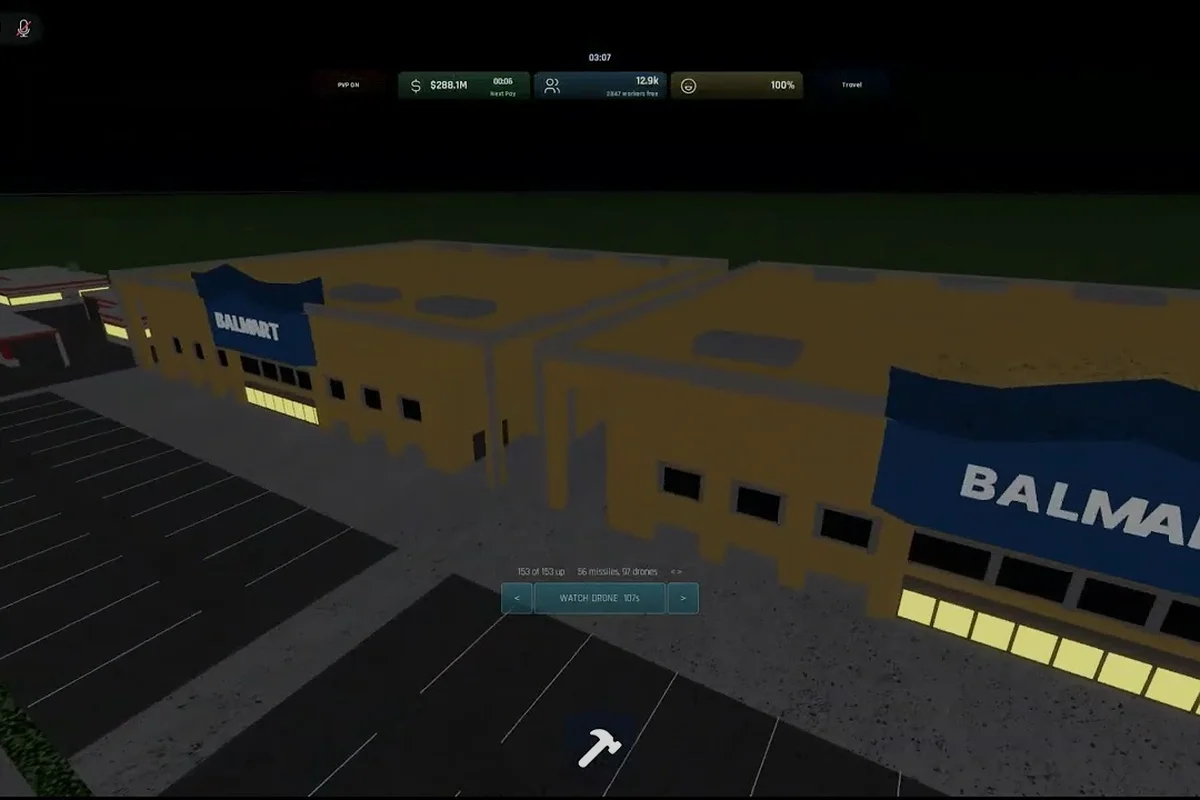
Choosing between the supermarket and the mall in Build and Conquer shapes your entire early-game economy, because one option delivers steady, low-risk income while the other unlocks a much larger revenue ceiling at a steeper setup cost. The Build and Conquer supermarket vs mall decision is not a simple upgrade path, since each building occupies a distinct role in your commercial district and competes for the same limited building slots. Understanding the income curve, happiness contribution, and footprint of each structure helps you avoid locking a weak anchor into your first expansion zone, which is why this comparison matters before you commit concrete and steel.
Supermarket vs Mall Core Income Comparison
The supermarket functions as your first reliable commercial anchor, providing a modest but consistent income stream that keeps your treasury stable during the early research phase. According to community data from the V0.1 beta, the supermarket generates a base income that is roughly 40% lower than the mall, but it costs significantly less to construct and requires no advanced research prerequisites. This makes the supermarket an ideal first commercial building when you are still unlocking basic infrastructure and cannot afford to tie up resources in a long construction timer.
The mall, by contrast, is classified as an A-tier income anchor in verified creator tests, which places it among the strongest passive revenue buildings in the current beta. Its higher output comes with a larger footprint and a higher upfront cost, meaning you need to plan your commercial district layout carefully before placing one. The income difference becomes more pronounced as your city grows, because the mall scales better with adjacent population density and benefits more from happiness multipliers than the supermarket does.
| Building | Tier Rating | Relative Income | Setup Cost | Footprint | Best Use Case |
|---|---|---|---|---|---|
| Supermarket | B-tier | Baseline (1.0x) | Low | Small | Early-game stability |
| Mall | A-tier | High (1.4x) | Moderate | Large | Mid-game income anchor |
| Mid-rise Apartment | B-tier | Population only | Low | Medium | Housing density |
The key takeaway is that the supermarket is not a "worse mall" but rather a stepping-stone commercial building that keeps your economy functional while you save for the mall. Players who skip the supermarket entirely often struggle with cash flow during the first 15 minutes, because the mall's construction time leaves a gap where no commercial income is flowing. The Build and Conquer supermarket vs mall comparison therefore hinges on timing as much as raw output.
Setup Cost and Happiness Trade-offs
Setup cost is the first major differentiator, and it extends beyond the initial resource price to include the opportunity cost of the building slot and the research time required to unlock each structure. The supermarket unlocks early and builds quickly, which means you can place one within the first few minutes of a match and start earning immediately. The mall requires a longer build time and often demands that you first stabilize your power grid, since a power shortage during construction can delay completion and waste valuable minutes.
Happiness gains represent the second major trade-off, because commercial buildings in Build and Conquer contribute to citizen satisfaction in different ways. The supermarket provides a small, flat happiness bonus that applies to nearby housing, while the mall delivers a larger bonus that scales with the number of connected residential zones. This scaling behavior means the mall becomes disproportionately valuable in dense city cores, whereas the supermarket remains a solid choice for satellite districts or early expansion zones.
| Factor | Supermarket | Mall | Winner |
|---|---|---|---|
| Unlock timing | Early | Mid-game | Supermarket |
| Base income | Low | High | Mall |
| Happiness bonus | Flat, small | Scaling, large | Mall |
| Build time | Short | Long | Supermarket |
| Slot efficiency | Low | High | Mall |
Because the mall's happiness bonus scales with residential density, placing it next to mid-rise apartments or other high-population housing maximizes its return. The supermarket's flat bonus is less exciting but more forgiving, since it performs adequately even in low-density areas where a mall would underperform relative to its cost. Community reports from the October 2026 beta consistently recommend building at least one supermarket before transitioning to mall-centric commercial layouts.
Research Order and Building Slot Priority
The Build and Conquer best research order question intersects directly with the supermarket vs mall decision, because unlocking the mall too early can leave you without the supporting infrastructure needed to capitalize on its higher income. Most experienced players recommend researching basic power stability and housing density upgrades before committing to the mall, since a mall without sufficient population nearby generates only marginally more income than a supermarket while costing far more.
Your first building slot should almost always go to the supermarket, because it provides immediate income with minimal risk and frees up your attention for military or infrastructure development. The second and third commercial slots are where the mall becomes the clear priority, assuming you have already secured a stable power supply and placed enough housing to justify the mall's larger footprint. This sequencing prevents the common mistake of building a mall too early and then watching it sit underutilized while your economy stagnates.
| Priority | Building | Reason |
|---|---|---|
| 1 | Supermarket | Immediate income, low risk |
| 2 | Power plant | Stable energy for expansion |
| 3 | Housing block | Population for mall scaling |
| 4 | Mall | High income once population exists |
| 5 | Second mall or defense | Scale economy or protect assets |
The Build and Conquer nuclear vs normal power plant decision also influences your commercial timing, because nuclear plants provide far more energy but require a much larger upfront investment and longer construction time. A normal power plant is usually sufficient to support your first supermarket and early housing, while a nuclear plant becomes necessary only when you are running multiple malls alongside energy-hungry military structures. Players who rush nuclear power before securing commercial income often find themselves resource-starved in the mid-game.
Strongest Units and Defense Considerations
Commercial buildings do not exist in a vacuum, because every resource you spend on a mall is a resource you cannot spend on the Build and Conquer strongest units or defensive structures. The Hypersonic BM and RA3 interceptor are both S-tier units in the current beta, and they require significant investment to field effectively. A well-timed mall can fund these units faster, but a poorly timed mall can delay your military development long enough for an opponent to seize the initiative.
The Build and Conquer weapon tier list places MRBM, Iron Dome, and Sea RAM in the A-tier, which means they are strong but not essential in every match. Your commercial income directly determines how quickly you can field these units, which is why the supermarket vs mall decision has military implications even though neither building produces combat power. A player who stabilizes income early with a supermarket can often afford an earlier Iron Dome, while a player who overinvests in a mall may find themselves defenseless during the construction window.
| Unit | Tier | Role | Income Dependency |
|---|---|---|---|
| Hypersonic BM | S | High-reliability strike | High |
| RA3 Interceptor | S | Top anti-air | High |
| MRBM | A | Mid-range ballistic | Medium |
| Iron Dome | A | Missile defense | Medium |
| Sea RAM | A | Naval anti-air (max 6) | Medium |
| GLCM | B | Ground-launched cruise | Low |
The Sea RAM cap of 6 per base is an important constraint that affects how much income you actually need to spend on defense, since you cannot simply spam unlimited anti-air units. This cap means a single well-placed mall can often fund your entire defensive network, while multiple supermarkets may be necessary to achieve the same income level if you prefer a distributed commercial layout. The Build and Conquer building tier list consistently ranks the mall above the supermarket for late-game income, but the supermarket's early availability keeps it relevant throughout the match.
Building Tier List Context and Long-Term Strategy
The Build and Conquer building tier list places the mall among the A-tier income anchors, which puts it in the same general category as other high-value economic structures but below the S-tier military assets that define late-game power. The supermarket sits in the B-tier, not because it is weak, but because its flat income and small happiness bonus simply do not scale as well as the mall's percentage-based contributions. Understanding this tier placement helps you avoid overvaluing the supermarket in the late game or undervaluing it in the early game.
Long-term strategy in Build and Conquer typically involves transitioning from a supermarket-based economy to a mall-based economy once your population density supports the larger building's scaling bonuses. This transition should happen gradually, because selling a supermarket to free up a slot for a mall creates a temporary income gap that can be exploited by aggressive opponents. Instead, most players expand to a new commercial district for their first mall while keeping the original supermarket operational.
| Strategy Phase | Commercial Focus | Military Focus | Key Risk |
|---|---|---|---|
| Early (0-10 min) | Supermarket | Basic defense | Cash starvation |
| Mid (10-20 min) | First mall | A-tier units | Construction window |
| Late (20+ min) | Multiple malls | S-tier units | Overextension |
The Build and Conquer best research order for commercial development follows a logical progression: unlock the supermarket immediately, research basic power and housing, then unlock the mall once your population can support its scaling bonuses. Rushing the mall before housing is a common mistake that leaves you with an expensive building generating supermarket-level income, which is why the sequencing matters more than the raw tier rating. For a broader look at how commercial buildings fit into your overall economic strategy, the Build and Conquer power plant guide covers energy infrastructure that directly supports mall-heavy layouts.
Frequently Asked Questions
Is the mall always better than the supermarket in Build and Conquer?
No, the mall is better in the mid-to-late game when you have enough housing density to activate its scaling bonuses, but the supermarket wins in the early game due to its lower cost and faster construction. Building a mall too early often produces supermarket-level income at a much higher price.
How many supermarkets should I build before my first mall?
Most community reports recommend building one supermarket as your first commercial anchor, then transitioning to malls once you have stabilized power and placed enough housing. A second supermarket is usually unnecessary unless you are playing a distributed-city strategy with multiple small residential clusters.
Does the mall generate happiness or just income?
The mall generates both income and a scaling happiness bonus that increases with nearby residential density, while the supermarket provides a smaller flat happiness bonus. This scaling behavior makes the mall particularly valuable in dense city cores where multiple housing blocks are connected to the commercial district.
What is the best research order for commercial buildings?
Unlock the supermarket first, then research basic power stability and housing density upgrades before committing to the mall. This order ensures your mall has sufficient population and energy to operate at full efficiency, rather than sitting underutilized in a low-density area.
Can I skip the supermarket entirely and rush the mall?
You can, but it is risky because the mall's longer construction time creates an income gap during the early game. Players who skip the supermarket often struggle to afford basic military units while the mall is still building, leaving them vulnerable to early aggression from opponents who stabilized their economy first.
The Build and Conquer supermarket vs mall decision ultimately comes down to timing and density, since the supermarket provides reliable early income while the mall rewards patient players who build the population infrastructure to support its scaling bonuses. A balanced approach that starts with a supermarket and transitions to malls as your city grows delivers the strongest economic curve across a full match. The official Build and Conquer Roblox game page provides the current beta version details, and community testing continues to refine tier placements as the October 2026 beta evolves.